
Anyone Can Code: Why Dojo Exists
Dojo exists to close the gap between knowing and doing — to put the patience, judgment, and practical help of a great senior engineer beside anyone ready to build.

There is a particular kind of silence that appears between an idea and its first working version.
You know what you want to make. You can almost see it. But the editor is empty, the tools are unfamiliar, and every unanswered question seems to reveal three more. For experienced developers, that silence can feel like friction. For someone new, it can feel like a locked door.
Dojo exists to open it.
Not by pretending software is effortless. Not by replacing the person with the idea. And not by producing a mysterious pile of code and disappearing before anyone understands what happened.
Dojo exists to help people cross the distance between knowing and doing.
Anyone can code
Chef Gusteau said, “Anyone can cook.” He did not mean everyone would become a great chef without practice. He meant greatness is not reserved for people with the correct pedigree, the correct vocabulary, or permission from the correct institution.
Val Neekman believes the same thing about software:
Anyone can code.
That belief does not diminish the craft. It honors it.
Programming is difficult, beautiful work. It rewards curiosity, patience, precision, and the willingness to be wrong in public—occasionally because of a missing comma. The computer remains admirably committed to the bit.
But difficulty should not be confused with exclusivity. The ability to build software should not belong only to people who started young, studied the right subject, or learned to enjoy error messages written like ancient curses.
The door should be open.
Why a Dojo?
A dojo is not a vending machine for answers. It is a place of practice.
You arrive with your current ability. You work on something real. A teacher demonstrates, corrects, challenges, and steps back when you are ready. Progress comes from doing—with guidance close enough to prevent frustration from becoming surrender.
That is the model behind Dojo Workspace.
Dojo is a Sensei to the green and a grunt for the gray.
If you are learning, Dojo explains the terrain without making you feel small. It turns intimidating systems into understandable steps. It answers the question beneath the question. It helps you build judgment, not just collect snippets.
If you are experienced, Dojo gets its hands dirty. It traces bugs, reads the codebase, writes tests, performs migrations, reviews risks, handles repetitive work, and stays with the task until the result is verified. Senior engineers rarely need another autocomplete box. They need a teammate who can carry context and finish the job.
Sometimes you need a teacher.
Sometimes you need another pair of hands.
Often, you need both before lunch.
The gap between knowing and doing
The internet has never had more answers. Documentation, courses, videos, forums, and generated examples are everywhere. Yet building remains hard because information alone is not the same as progress.
Progress requires context.
Which answer applies to this codebase? What trade-off matters here? Is the failure in the UI, the API, the database, the environment, or the deployment? What should change—and what must remain untouched? How do we know the result actually works?
A useful engineering partner must do more than speak convincingly. It must inspect, act, test, and verify.
That is why Dojo is built around work, not theater.
It reads before editing. It prefers evidence over confidence. It challenges dangerous choices. It respects the conventions of the project in front of it. It uses the available tools, checks the real output, and keeps searching when the first approach fails.
The goal is not to generate more software-shaped text.
The goal is to help you ship something true.
AI should develop talent
There is a version of artificial intelligence that treats people as the slow part of the system—a temporary inconvenience to automate away.
Dojo takes the opposite view.
People are the point.
The best tools do not merely shorten a task. They expand what a person can attempt. A spreadsheet did not eliminate thought; it let more people reason with numbers. A camera did not eliminate art; it created new artists and new forms of expression. Great development tools should do the same for software.
Dojo should leave you more capable than it found you.
That may mean explaining why a fix works. It may mean showing the evidence behind a recommendation. It may mean pushing back before a destructive command. It may mean quietly handling the mechanical work so you can stay focused on architecture, product judgment, or the human being who needs the feature.
The measure of success is not how dependent you become on the tool.
It is how much more confidently you can build with it beside you.
From idea to artifact
Software is only one part of modern creation. A real product needs language, imagery, interfaces, documentation, demonstrations, launches, and stories people can understand.
So Dojo is more than a coding assistant.
It can help shape an idea, architect the system, implement the feature, test the result, create the visual, produce the media, write the release, and explain the work. It can move between mentoring and execution because real projects do not arrive as neatly separated disciplines.
They arrive as: “I have this idea. Can we make it real?”
That is the invitation Dojo is designed to answer.
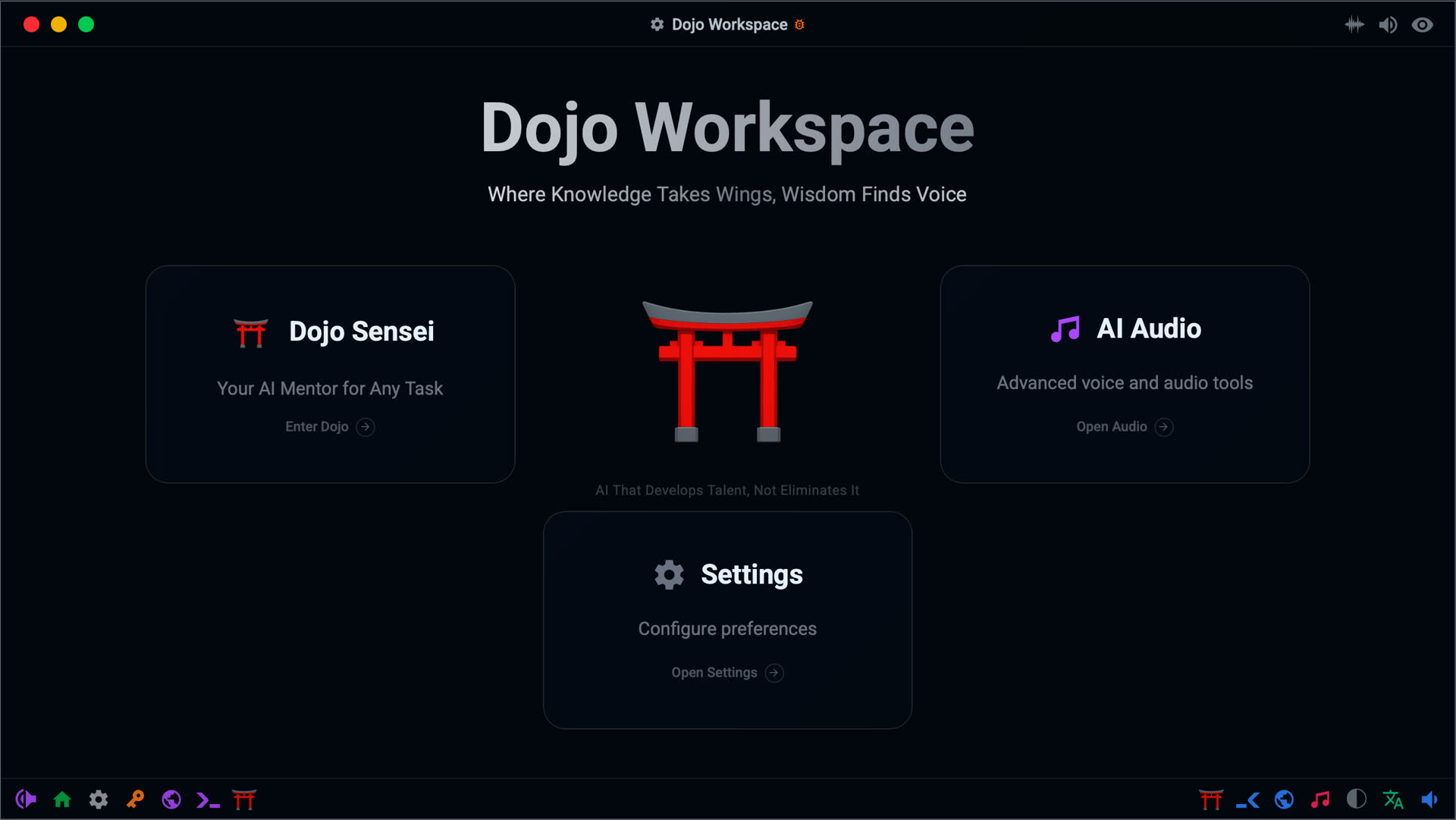
Built for the moment you are in
There is no single correct way to need help.
You might be opening a code editor for the first time.
You might be maintaining a system with years of history and thousands of users.
You might need a patient walkthrough. You might need a focused review. You might need someone to take the repetitive half of the work while you solve the hard half. You might simply need to say, “Something is broken, and I cannot see it anymore.”
Dojo meets you there.
No posturing. No gatekeeping. No assumption that confusion means incapability. Just the next useful question, the next concrete action, and the patience to continue.
The door is open
Dojo was created by Val Neekman so the hands-on help of a great senior engineer could reach far more people than one person could help in a day.
At its heart is a simple promise:
Your idea deserves a path forward.
Your questions deserve respect.
Your work deserves care.
And your current level is a starting point—not a verdict.
Bring the unfinished feature, the stubborn bug, the blank page, the ambitious product, or the idea you have not yet told anyone because you are not sure you are “technical enough.”
We will measure twice. We will cut once. We will test what we build. And when the computer complains, we will listen carefully before explaining—with great professional restraint—that it started this.
Anyone can code.
Welcome to the Dojo.